

Understanding Quotex Login Process
🔐 Learn how to easily log in to Quotex with step-by-step tips, secure account access, and quick fixes for common login problems to keep your trading smooth.
Edited By
Isabella Clarke
The question mark (?) plays a vital role in English writing, especially when clarity and tone matter. For traders, investors, and finance professionals, using question marks correctly can make communication precise and impactful. Misplaced or missing question marks may cause confusion or alter the intended meaning.
Originating in medieval times, the question mark was developed to indicate rising intonation in speech, signalling a query. Today, it mainly appears at the end of direct questions. For example:

"What is the current Sensex value?"
"Are you planning to invest in the upcoming IPO?"
Correct use includes interrogative sentences, rhetorical questions, and sometimes polite inquiries. However, indirect questions do not require a question mark, such as: "I wonder whether the stock will rise tomorrow."
Using question marks accurately helps maintain tone and clarity, especially in written reports and analyses where precise questioning can guide decisions.
Common errors traders and analysts should avoid include:
Placing question marks after statements ("The stock price fell yesterday?").
Using multiple question marks unnecessarily ("Will the market recover soon??").
Omitting question marks at the end of direct questions.
Besides traditional writing, question marks also affect tone in emails, chat, and digital communication. For example, a well-placed question mark can soften requests or invite discussion. Misusing them may come across as rude or impatient.
Understanding regional variations is useful too. In informal Indian English, question tags like "isn't it?" often accompany statements to seek confirmation politely.
Overall, mastering the nuances of question marks can improve how you query data, pose investment questions, or draft analytical reports. This enhances both comprehension and professionalism in finance-related writing.
Understanding the origin and role of question marks helps clarify why this punctuation mark is so essential today. The question mark directs readers to interpret sentences as enquiries, guiding tone and response expectations. For traders, analysts, or any professional dealing with large volumes of written information, recognising the question mark's role can prevent misreading data requests and support clearer communication.
In early Latin and Greek manuscripts, punctuation was minimal or absent. Scribes used spaces or simple marks to break sentences, but there was no standard symbol to signal questions. This made interpreting written queries tricky, especially in legal, commercial, or scholarly documents where precise meaning mattered.
In the 7th century, Irish monks began to develop early punctuation systems to aid reading aloud. They sometimes used a punctus interrogativus, a mark resembling a tilted semicolon, to signal questions. However, these marks were inconsistent, and most readers still relied on context to identify queries.
By the late medieval period, the question mark began to take a more familiar form. One explanation traces its origin to the Latin word "quaestio" (meaning "question"), which scribes abbreviated as a "q" written above an "o". Over time, the "q" shrank into a curved line over the "o", which gradually simplified into the modern question mark.
Its adoption in print helped standardise interrogation signalling. This shift allowed readers to instantly recognise questions, improving clarity in contracts, financial documents, and correspondence. For example, an invoice with a clear question mark directs immediate attention to issues or clarifications needed, reducing costly misunderstandings.
The primary function of the question mark is to indicate that a sentence asks a direct question. Without it, statements like "Are the markets stable" could be misread as a declaration rather than a request for information.
In financial analysis, this distinction is important. Consider a report stating, "Will the company meet its quarterly targets?" The question mark signals an enquiry, setting expectation for further data or projection. Without it, sentences may lose their interrogative function, muddling decision-making.
Beyond marking interrogatives, question marks influence tone. They can soften statements, making communication more polite or inviting. For instance, "Could you review the portfolio?" feels more courteous than a blunt request.
On the other hand, question marks can convey surprise or doubt. In stock market news, "Is the Sensex really falling this sharply?" reflects scepticism or urgency. Recognising these nuances helps professionals respond appropriately, whether analysing reports or communicating with clients.
Clear use of question marks not only structures sentences but also shapes how the message is received, which is vital in financial contexts where precision matters.
By tracing its origins and understanding its roles, you can use question marks more effectively to craft clear, respectful, and impactful communication in your professional writing.
Understanding where and how to use question marks is essential for clear communication, especially in finance and analysis where precision matters. Question marks not only signal inquiries but also influence tone and reader interpretation. Misplacing them can lead to confusion, affecting the clarity of reports, emails, or market commentary.
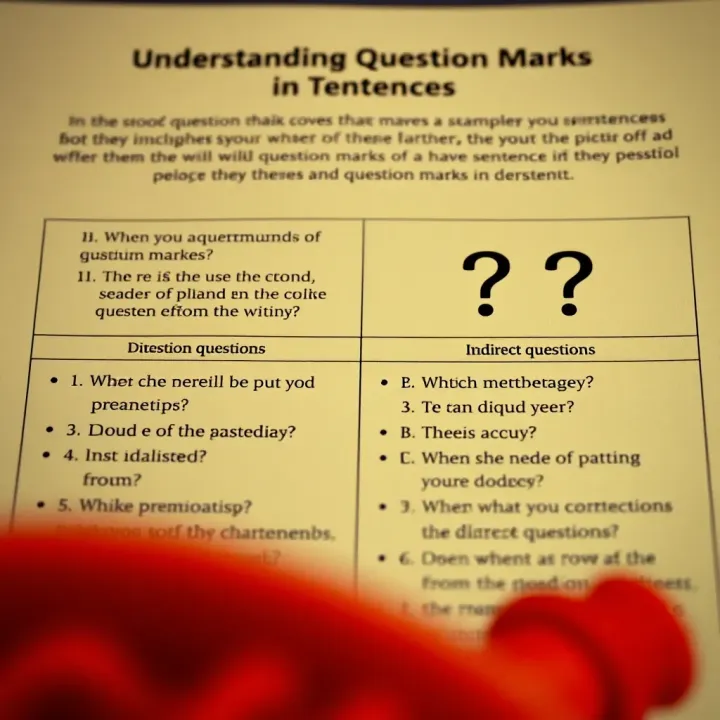
Direct questions end with a question mark because they seek an answer explicitly. For example, in client communications, asking "Have you reviewed the quarterly earnings report?" clearly marks the sentence as a request for information. Always place the question mark at the end of the direct question, even if it’s embedded in a longer sentence: "Could you tell me, has the CEO announced any changes?"
In contrast, embedded questions are questions included within statements or other questions and typically do not end with a question mark. For instance, "I wonder whether the market will react to the RBI’s decision" is not a direct question but a statement about a question. Adding a question mark here would confuse readers. Avoid using question marks for indirect enquiries to maintain professionalism and clarity.
When a question deserves strong emotion or surprise, a question mark followed immediately by an exclamation mark can be used. For example, "Did the Sensex really drop 1,000 points?!" captures shock effectively. However, limit this in formal writing; use it mainly in informal contexts like internal chats or social media.
Handling question marks with quotations or parentheses can be tricky. If the quoted material is a question, the question mark stays inside the quotation marks: She asked, "Are the earnings figures accurate?" If the whole sentence is a question but the quoted phrase isn’t, place the question mark outside: Did he really say, "Market volatility is over"?
Similarly, when a question mark relates to a part of the sentence in parentheses, it stays inside if it concerns the parenthesis content only: The forecast (will the inflation rate drop?) remains uncertain. If the entire sentence is a question, the mark goes outside: Will the market stabilise soon (considering recent events)?
Proper grammar with question marks ensures your communication is precise and professional, helping prevent misunderstandings in critical financial discussions.
By mastering these placement rules, traders, analysts, and investors can enhance the clarity and impact of their written communication, avoiding ambiguity that might affect decision-making.
Different types of questions demand distinct punctuation to convey the intended meaning clearly. Understanding these variations helps avoid confusion, especially in professional writing where clarity is non-negotiable. Finance professionals, traders, and analysts often rely on precise communication, making mastery over these punctuation rules essential. Let's explore key question types and how punctuation shapes their use.
Yes/no questions expect a straightforward affirmative or negative answer. In spoken English, the intonation usually rises at the end, signalling a query. For example, "Are quarterly results improving?" raises the pitch to highlight it’s a question. Recognising this helps in structuring sentences that invite succinct responses, which is invaluable during meetings or reports.
In writing, yes/no questions always end with a question mark. Consider: "Did the stock hit the target price today?" This punctuation cue immediately signals to readers that an answer is expected. Misplacing or omitting the question mark can leave the sentence ambiguous — readers might interpret it as a statement.
Tag questions combine a statement with a mini-question, often used to seek confirmation. For instance, "The market closed higher today, didn’t it?" The first part asserts, and the tag turns it into a question. English rules dictate the tag verb and subject must agree in tense and number with the main sentence, ensuring grammatical accuracy and clear meaning.
Tag questions end with a question mark because the entire sentence functions as a question. However, when tag questions are polite or rhetorical, the tone softens. For example, "You’re joining the board meeting, aren’t you?" Using the question mark respects this nuance, inviting a response without sounding overly forceful.
Not all questions require a question mark. Rhetorical questions, meant to provoke thought rather than elicit answers, sometimes do not end with one. For example, "Who doesn’t want consistent portfolio growth?" usually carries a question mark because it’s rhetorical. But indirect questions embedded within statements often avoid the question mark. Think: "I wonder if the market will rally tomorrow." Here, the structure is declarative despite asking a question, so no question mark appears.
Avoiding a question mark in indirect questions or rhetorical queries can lend a formal, reflective tone to a text. This subtlety helps writers convey uncertainty or introspection without breaking flow. Traders producing detailed reports might prefer this style to maintain professionalism while raising complex issues.
Proper punctuation in different question forms isn’t just about grammar; it shapes how your message is received and understood in the world of finance and business communication.
By appreciating these nuances, writers in trading and analysis can craft messages that are precise, clear, and appropriately toned, preventing miscommunication and ensuring their points land exactly as intended.
Question marks play a vital role in clarifying interrogative intent, but misusing them can damage clarity and confuse readers. For finance professionals, traders, and analysts, precise communication is non-negotiable—especially when explaining market trends or investment queries. This section highlights common pitfalls with question marks and offers practical tips to use them correctly.
Leaving out a question mark where it should stand can turn a direct query into a bland statement, making the reader uncertain about your intent. For instance, "Are the Sensex levels stabilizing" without the question mark reads like a declaration, which blurs its purpose. Similarly, putting a question mark at the wrong place can confuse the reader. Consider: "The trader said, ‘Will the market crash?"' Here, missing the closing quotation mark or improperly placing the question mark breaks sentence flow and causes ambiguity.
Misplaced or missing question marks affect how clear and professional your message seems. This can impact investor confidence or misdirect analysts who rely on unequivocal data and queries in reports.
Always position the question mark at the end of a direct question, including inside quotation marks when quoting someone’s query. For embedded questions, do not place a question mark if the sentence itself is not interrogative. Take this example: "Could you explain how the GST change will affect trading volumes?" Here, the question mark correctly ends the entire sentence. Conversely, "I wonder if the GST change will affect trading volumes" is a statement and does not need a question mark.
Review your sentences for punctuation after quoted questions and compound queries. Ensuring proper placement avoids misunderstandings and maintains polished communication, especially in presentations or official emails.
Using question marks excessively, such as multiple marks in a row or peppering every sentence with one, can make your tone seem overly emotional, unsure, or informal. In the world of finance and investment, this may come across as unprofessional or even create doubts about your expertise. For example, writing "Are you sure about the stock’s future??" or "Why is the market fluctuating???" confuses the reader by distracting from the actual message.
Excessive question marks dilute the impact of genuine queries and can reduce trustworthiness, particularly in reports or analyses meant to convey confidence and clarity.
Use only one question mark per sentence, even if the question is strong or urgent. When you want to express surprise or emphasis, opt for words or sentence structure rather than punctuation overload. For instance, instead of "Is this stock really going to crash???", write "Is this stock really going to crash? This seems unexpected."
Moderating question mark use enhances readability and ensures your questions stand out without sounding dramatic. It keeps your writing sharp, professional, and easy to follow for investors, brokers, and analysts alike.
Proper punctuation sharpens your communication. Avoid common question mark errors to maintain clarity, professionalism, and reader trust. These small adjustments make a big difference in financial contexts where every word counts.
Question marks do more than signal interrogative sentences; they shape the tone and style of communication, especially in today’s fast-moving digital world. Their subtle impact on politeness, emphasis, doubt, and surprise influences how readers perceive a message. For traders, investors, and analysts, understanding this nuance helps avoid miscommunication, especially when conveying queries or clarifying uncertainties.
Using a question mark can soften a statement, making it sound more polite or less direct. For instance, in business emails, "Could you send the report by tomorrow?" sounds more courteous than "Send the report by tomorrow." This small punctuation mark helps maintain professional tone without sounding demanding. Moreover, adding a question mark can also stress particular information, such as in, "You're attending the meeting tomorrow?" emphasising the query and prompting confirmation.
Question marks play a key role in expressing uncertainty or surprise beyond mere factual questioning. A sentence like "You finished the deal so quickly?" conveys disbelief or amazement about the speed. This tone can carry different meanings depending on context and intonation, helping readers grasp underlying emotions. In financial discussions, such subtlety aids in highlighting unexpected results or cautious optimism effectively.
In messaging apps and texts, question marks often convey tone more than content. Multiple question marks "Why delay the payment??" can express urgency or frustration. Conversely, a single question mark at the end of short texts serves as an invitation to respond or clarify. Understanding this usage is vital for finance professionals as quick digital exchanges often lack vocal cues, requiring careful punctuation to maintain clarity and professionalism.
Digital communication reflects cultural habits in punctuation. Indian English writers might use fewer question marks in formal emails but more in casual chats, influenced by local languages and communication style. Meanwhile, Western digital users may prefer more explicit questioning forms. Recognising these variations helps avoid misinterpretation, especially when working with international clients or teams.
Indian English often integrates traditional and modern punctuation preferences. Question marks appear in formal writing as expected but sometimes get omitted in colloquial or informal notes, relying on context to indicate a question. This practice affects tone and can confuse non-Indian recipients unfamiliar with these conventions. Professionals should balance local norms with international clarity depending on the audience.
Local Indian languages influence how question marks are used in English. Many Indian languages use intonation or specific question particles instead of punctuation. This leads to sentences like "You are coming?" without a question mark, which sounds acceptable in spoken Hindi or Tamil but less so in strict English writing. Awareness of this helps brokers, analysts, and investors refine their writing to be clearly understood, especially in regulatory or transaction documents.
In sum, understanding question marks beyond grammar enhances your communication by fine-tuning tone and aligning with cultural expectations, crucial for effective financial and business writing today.
🔐 Learn how to easily log in to Quotex with step-by-step tips, secure account access, and quick fixes for common login problems to keep your trading smooth.

Explore QX Affiliate 👥 for top affiliate marketing ways 📈. Learn how it works, benefits & tips to earn 💰 by growing your online presence 🌐.

Explore Rifa FX in forex trading 💹: key concepts, tools, strategies, risk management, and challenges to help Indian traders make smarter decisions.

📊 Master range markets in India with this guide! Learn to spot patterns, use technical tools, manage risks, and trade smartly within stable price bands.
Based on 9 reviews