
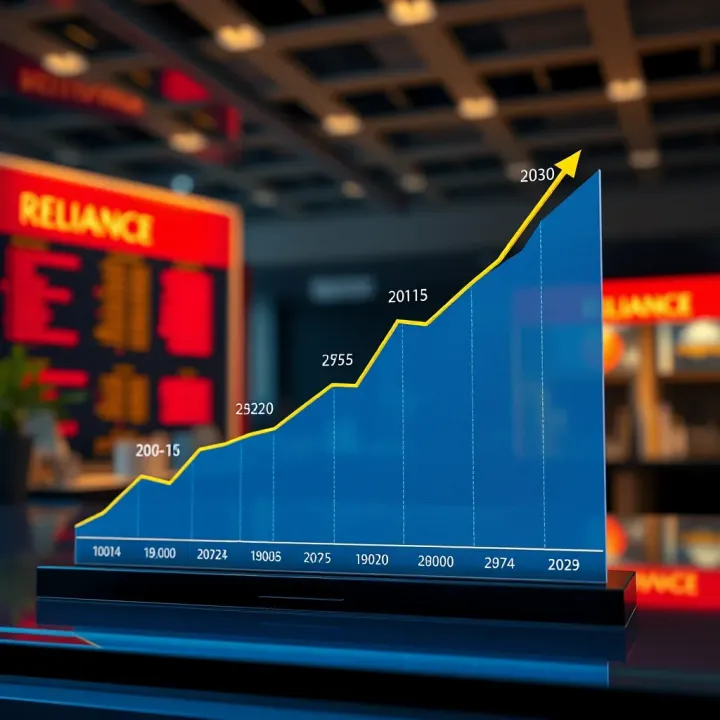
Reliance Industries Share Price Forecast by 2030
📈 Explore Reliance Industries' share price outlook by 2030. Analyze trends, company strength, sector impact & economic factors shaping long-term investor views.
Edited By
James Thornton
MRF Limited stands as one of India's premier tyre manufacturers, with a legacy spanning over seven decades. Its share price movement often reflects not only company-specific developments but also broader industry trends and macroeconomic factors affecting the automotive and rubber sectors.
As the Indian economy is projected to grow steadily, supported by rising vehicle sales and infrastructure expansion, MRF's prospects appear promising. However, the company faces challenges such as raw material cost volatility and changing regulatory landscapes.

Investors eyeing MRF's stock till 2030 should consider several key factors influencing its price:
Industry dynamics: Growth in passenger and commercial vehicles, shifts toward electric vehicles (EVs), and tyre replacement cycles.
Financial health: Consistent revenue growth, profit margins, and debt levels backed by quarterly earnings data.
Raw material prices: Natural rubber and synthetic rubber form a significant chunk of input costs, impacting profitability.
Government policies: Import duties, environmental regulations, and incentives for green technologies can influence operations.
Understanding these elements helps assess how MRF might navigate opportunities and risks ahead, shaping its market valuation.
Besides tangible financial metrics, market sentiment shaped by expert forecasts and geopolitical changes will also play a role. For instance, disruptions in global supply chains or fluctuations in foreign exchange rates can affect costs and earnings.
In sum, MRF's share price outlook till 2030 will hinge on its ability to innovate, maintain operational efficiency, and adapt to evolving market conditions. This article will unpack these factors in detail, equipping investors with insights to make informed decisions.
Understanding MRF’s current market position is essential for investors looking to assess its long-term share price potential. This overview sets the stage for analysing factors that will drive growth or pose challenges till 2030. It offers a snapshot of how well MRF is placed within the tyre industry, highlighting its strengths, recent financial health, and share price movements — all crucial for informed decision-making.
MRF Ltd (Madras Rubber Factory) stands as India’s largest tyre manufacturer, with a diversified portfolio covering passenger vehicles, commercial vehicles, two-wheelers, and off-road tyres. Beyond tyres, it has ventured into paints and other rubber products, but tyres remain its core business. This focus has helped MRF build a strong brand reputation and a loyal customer base across urban and rural India. For example, in 2023, MRF's supply to automobile giants like Tata Motors and Maruti Suzuki reinforced its foothold in the OEM (original equipment manufacturer) segment, which provides steady revenue streams.
MRF’s financial results over the past few years paint a picture of resilience despite market volatility. The company reported a revenue of around ₹12,000 crore in FY 2023, showing steady growth compared to previous years. Profit margins, however, have faced pressure due to rising raw material costs, particularly natural rubber and synthetic rubber imported from Southeast Asia. Nevertheless, MRF managed operational efficiencies and launched premium tyres with better margins to offset some costs. This balance between volume growth and margin management is a key consideration for investors looking at sustainable earnings.
Looking at MRF’s share price over the last five years, its trajectory reflects both the broader market trends and company-specific developments. The stock witnessed solid growth between 2017 and 2019, buoyed by steady demand and improved product mix. The pandemic in 2020, however, caused a sharp but brief dip, mirroring India’s economic slowdown. Since then, MRF’s price has rebounded, supported by strong automotive demand and an uptick in rural consumption, which drives tyre volumes. Yet, the share remains relatively high-priced compared to peers like Apollo Tyres, making valuation an important checkpoint for investors.
Tracking MRF’s market position today helps decode its performance drivers and potential headwinds, forming a foundation for the detailed outlook till 2030.
This section is foundational, giving investors a clear context before exploring deeper factors influencing MRF's share price growth and risks ahead.

Understanding the factors that could shape MRF’s share price until 2030 helps investors make informed decisions based on realistic expectations. These factors range from industry-specific trends to broader economic policies, each interacting to impact MRF’s valuation in distinct ways. Focusing on these key influences offers traders and analysts clarity on potential growth trajectories and risks.
The demand for automobiles directly drives tyre consumption, making automotive industry trends a primary factor for MRF. India’s ongoing rise in vehicle ownership—especially two-wheelers and passenger cars—fuels tyre sales steadily. For example, rising preference for electric vehicles (EVs) could change tyre specifications, pushing MRF to adapt its products. Besides, government incentives to boost rural mobility and infrastructure expansion under schemes like Bharatmala encourage vehicle sales in tier-2 and tier-3 cities. This demand ripple benefits tyre manufacturers, with MRF poised to capture market share if it stays agile.
Tyre production hinges on raw materials like natural rubber, synthetic rubber, carbon black, and petroleum derivatives. Fluctuations in these commodity prices affect MRF’s profit margins significantly. For instance, a surge in natural rubber prices, often influenced by climate conditions in Kerala and Tamil Nadu, can tighten margins if costs aren't passed on swiftly. Supply chain disruptions—think of the Covid-19 pandemic or logistics strikes—can also delay production or inflate costs. MRF’s ability to manage supplier relationships, diversify sourcing, and control inventory directly affects its cost efficiency and share price stability.
Innovation plays a key role in sustaining MRF’s competitive edge. The company’s investments in research and development (R&D) to produce durable, fuel-efficient tyres tailored for diverse Indian road conditions often translate into higher sales and better brand loyalty. For example, launching tubeless tyres compatible with newer vehicles adds value and attracts customers. Expanding into related segments like conveyor belts and industrial rubber products also broadens revenue streams. Thus, continuous product advancement and diversification can boost investor confidence and reflect positively on stock performance.
Policies on manufacturing, exports, and environmental compliance heavily influence MRF’s operations. The Indian government’s push for cleaner manufacturing through standards like the Bureau of Indian Standards (BIS) and pollution control norms require compliance, sometimes increasing short-term costs. On the flip side, incentives under the Production Linked Incentive (PLI) scheme or export promotion measures encourage capacity enhancement and global market access. Taxation policies, including changes in GST rates or import duties on raw materials, also affect pricing and margins. A stable, supportive regulatory landscape helps MRF plan long term and attract investment.
Focusing on these factors offers a realistic lens through which one can gauge MRF's share price trajectory, helping investors balance growth expectations with risk considerations.
Understanding expert predictions and market sentiments is vital for anyone tracking MRF’s share price outlook. These insights offer a snapshot of how analysts and investors perceive the company's future prospects, influencing market behaviour and guiding investment decisions. In the Indian stock market, where macroeconomic factors and sectoral trends often shift quickly, expert opinions help identify realistic price targets and potential risks ahead.
Analyst forecasts provide a quantitative assessment based on the company’s fundamentals, industry positioning, and external economic factors. For MRF, top brokerage houses and financial analysts typically consider variables like volume growth in the automotive sector, raw material cost trends, and technological upgrades in tyre manufacturing. For example, analysts at Motilal Oswal projected a compound annual growth rate (CAGR) of around 8–10% in MRF’s earnings over the next five years, reflecting optimism on demand recovery post-pandemic.
Price targets give traders a concrete figure to weigh against the current market price. As of mid-2024, consensus targets hover between ₹90,000 and ₹1,10,000 per share, factoring in steady revenue growth and moderate inflation impact on costs. However, these targets shift with quarterly results, raw material price fluctuations, or regulatory changes affecting the automotive industry. Regularly tracking these forecasts offers you an edge in timing your trades.
Market sentiment often mirrors investor confidence, shaped by news flow, quarterly earnings, and sectoral outlooks. For MRF, sentiment has oscillated, especially after raw material price volatility and global supply chain disruptions. Still, institutional investors continue to hold significant stakes, signalling long-term faith in the company.
Behaviourally, MRF’s shares tend to see momentum trading during festive seasons or major launches in the automotive sector. Retail investors pay close attention to dividend declarations, given MRF’s reputation for steady payouts. A drop in confidence usually coincides with abrupt raw material price hikes or global economic slowdowns affecting automobile sales.
Expert views and market mood are not just abstract statistics — they reflect real money flowing in and out, impacting stock prices daily. Staying updated with these can help you avoid pitfalls and capitalise on opportunities.
In summary, analyst forecasts offer a compass for expected share price movements, while investor confidence colours the market's immediate response. Both are crucial in shaping MRF’s journey to 2030 and should feature prominently in your investment strategy.
Understanding potential risks is essential for investors eyeing MRF's stock up to 2030. These risks may affect the company’s earnings, market valuation, and share price volatility. A clear grasp of challenges helps in shaping realistic expectations and making informed investment decisions.
Economic downturns in India or globally can hit MRF’s financials hard. Reduced consumer spending and lower vehicle sales directly affect tyre demand. For instance, during the 2020 pandemic-driven slowdown, MRF’s sales volumes shrank, putting pressure on margins. Currency fluctuations and market turbulence sway investor sentiment, causing stock price swings. Moreover, tightening monetary policies by the Reserve Bank of India (RBI) could increase borrowing costs, limiting MRF’s expansion plans.
Investors should consider how cyclical economic trends influence MRF, noting that volatility often leads to sharp share price corrections even if the company’s fundamentals remain steady.
The tyre market in India is fiercely competitive, with players like Apollo Tyres, JK Tyre, and international brands such as Michelin and Bridgestone expanding their footprint. MRF faces price wars and margin pressures, especially as rivals introduce advanced products and offer aggressive financing schemes. Also, new entrants focusing on electric vehicle tyres or eco-friendly materials could disrupt MRF’s market share. Staying ahead requires continuous innovation and effective marketing, but failing this can erode its stock appeal.
MRF relies heavily on raw materials like natural rubber, synthetic rubber, and carbon black. Price volatility in these commodities, often influenced by global supply-demand factors or geopolitical tensions, impacts production costs. For example, a sudden spike in crude oil prices typically pushes synthetic rubber prices up. India’s dependence on rubber imports means currency depreciation also inflates costs. Such cost pressures may reduce profitability unless MRF passes these on to customers, which is not always feasible in a price-sensitive market.
Investors must weigh these risks carefully against growth prospects. While MRF has shown resilience, these factors could trigger stock price fluctuations, which makes timing and strategy crucial for investment decisions.
Investing in MRF requires a clear understanding of its long-term prospects and valuation nuances. As the tyre industry navigates technological shifts and economic cycles, prospective investors must weigh growth potential alongside market valuation to make well-informed decisions. This section sheds light on the key investment factors that can influence returns on MRF shares up to 2030.
MRF has shown consistent expansion over the years, driven by strong demand across commercial and passenger vehicle segments in India. With the automotive industry gradually adopting electric vehicles, MRF’s ability to innovate with specialised tyres for EVs could boost its market share. The company’s focus on research and development, like recent introductions in tubeless and radial tyres, positions it well for growth.
On the dividend front, MRF has maintained a steady track record of rewarding shareholders. For example, during FY 2022-23, it declared a dividend yield near 1%. While this might seem modest compared to some FMCG stocks, the dividend is a reliable income source for long-term investors. Plus, given MRF’s sound cash flows, the company has the flexibility to enhance dividends if growth translates into higher profits.
For traders and long-term investors alike, MRF’s valuation is critical when deciding the right time to enter. Its Price-to-Earnings (P/E) ratio often trades above the industry average due to its premium brand status. Currently, if the P/E stands around 40, investors may want to watch for corrections or consolidation phases as opportunities to buy at better prices.
Investors should also consider MRF’s Price-to-Book (P/B) ratio and Dividend Yield in their decision-making. When P/B approaches historical lows, while dividends remain steady, it signals a potentially attractive entry point. Systematic Investment Plans (SIP) in MRF stock could work well in such periods, helping average out price fluctuations.
A tactical approach combining fundamental analysis with market timing can help manage entry risks, particularly given MRF’s exposure to raw material price swings and competition.
In summary, MRF’s reliable dividend payout, coupled with its innovation-driven growth, makes it a strong contender for a long-term portfolio. Yet, mindful valuation assessment remains vital. Investors should track sector trends and quarterly results to align their entry strategy with market realities rather than chasing short-term price movements.
📈 Explore Reliance Industries' share price outlook by 2030. Analyze trends, company strength, sector impact & economic factors shaping long-term investor views.

🔍 Explore Reliance Industries' share price targets & strategic outlook to 2030. Understand key growth drivers, market trends & expert forecasts 📈

📈 Explore Reliance Industries' growth prospects and share price target for 2030. Understand key market drivers and potential risks shaping its future today.
📈 Explore Reliance Industries' share price forecast by 2030 with insights on market position, financials, sector trends, challenges, and expert views.
Based on 14 reviews